
When to replace a bike chain: the signs, how to measure and why waiting is expensive
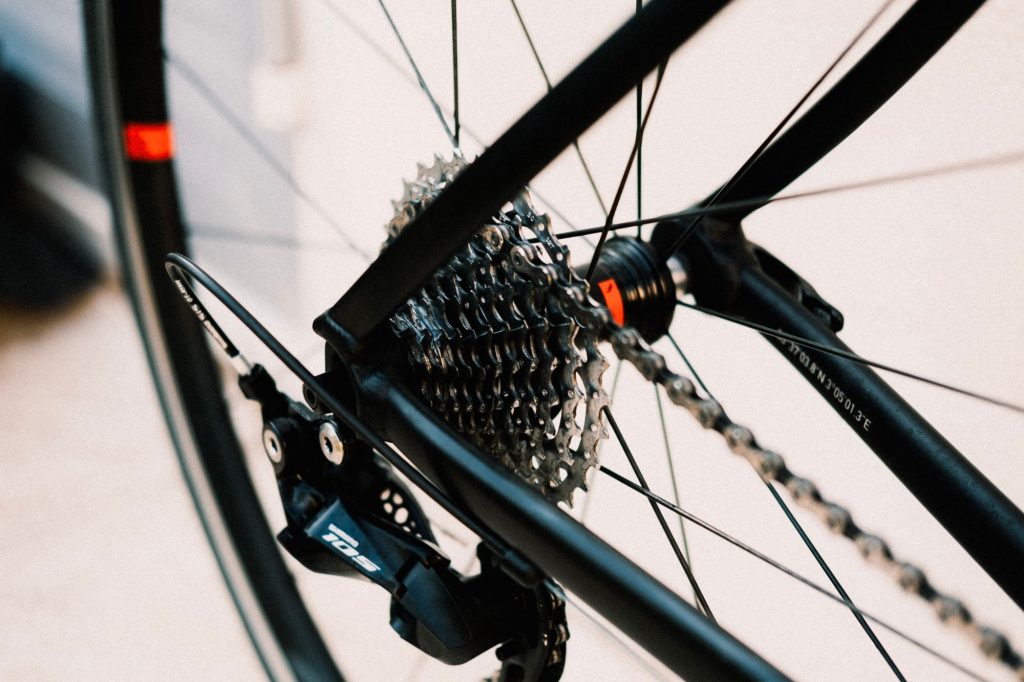
A bike chain needs replacing once it has stretched 0,5–0,75 %. You measure this with a cheap chain gauge and it takes under a minute. Replaced in time, a chain costs from about €10 for a city bike to €30-45 for an 11 or 12 speed drivetrain. Ridden too long, it wears out the cassette and the chainrings, and then the whole set has to go, which often comes to more than €100.
The chain is the cheapest part of the drivetrain and the only one designed to wear out first. That is why it is called the sacrificial part: replace it in time and you protect the expensive components. This guide explains how to spot a worn chain without tools, how to measure it accurately, and what to do if you have already left it too late.
The short answer: when to replace a bike chain
Chain wear is measured as a percentage showing how far it has stretched compared with a new one. That figure decides whether replacing the chain alone will do.
| Wear | What to do | What to expect |
| Up to 0.5 % | The chain is still good | Lubricate it and carry on |
| 0,5 % | Replace the chain (11-12 speed) | The cassette stays healthy |
| 0,75 % | Replace the chain (8-10 speed) | Worth checking the cassette |
| 1.0 % and more | Replace the chain and the cassette | Often the chainrings too |
The main rule: the more speeds, the narrower the chain and the sooner it has to go. A 12 speed chain wears faster than an older 8 speed one, because its plates are thinner.
1. Why a worn chain eats the cassette
A chain wears not because the metal stretches, but because the pins and bushings in each link wear away. The spacing between links grows a little at a time, and the chain stops matching the teeth on the cassette.
When the pitch no longer matches, the load falls on one or two teeth instead of being spread across them all. The teeth slowly take on the shape of the worn chain, turning pointed and hooked. From then on a new chain will not hold on the old cassette: it skips, especially when you push hard uphill.
The practical consequence is simple. A chain costs €10-45 depending on the number of speeds. A cassette usually costs €35-65, and together with chainrings the total often goes over €100. The only thing that decides which you pay is whether the chain was replaced in time.
2. Signs you can spot without tools
A worn chain almost always announces itself before you measure it. The most common signs:
- The chain skips under load: pushing hard away from the lights or uphill, the pedal suddenly gives way;
- the gears shift imprecisely, even though the cable and the derailleur are adjusted;
- you hear crunching in the smaller sprockets;
- the chain drops off more often than it used to;
- the cassette teeth look pointed, like waves or hooks.
A quick check with no tools at all: put the chain on the largest chainring and pull it forward at the middle of the ring. If it lifts far enough that you can see almost the full height of a tooth, it is badly worn.
These symptoms overlap with the ones we described in the seasonal servicing article, and the chain is the most common cause of them.
3. How to measure chain wear
With a chain gauge (most accurate)
A chain gauge is a plate marked 0.5 / 0.75 / 1.0%, and costs from about €9. Measuring takes seconds: hook one end over a link and drop the other into the chain.
- It does not drop in at 0.5%, the chain is fine;
- it drops in at 0.5%, time to replace an 11 or 12 speed chain;
- it drops in at 0.75%, replace any chain and check the cassette;
- it drops in at 1.0%, you will almost always need a new cassette too.
With a ruler (if you have no gauge)
On a new chain, 24 links measure exactly 304.8 mm (12 inches). Measure from pin centre to pin centre across 24 links:
- up to 306 mm, the chain is still usable;
- 306–307 mm, it is time to replace it;
- more than 307 mm, replace it together with the cassette.
Measure along the taut upper run of the chain so that it does not sag.
4. How long a chain lasts and when to check it
On average a bike chain lasts 2 000–5 000 km, and the gap between those figures comes down almost entirely to care and conditions.
| Conditions | Approximate life |
| Dry tarmac, regular cleaning and lubrication | 4 000–5 000 km |
| City, mixed weather | 2 500–3 500 km |
| Rain, gravel, forest tracks | 1 500–2 500 km |
| E-bike (higher loads) | 1 500–3 000 km |
A practical schedule: check the chain kas 500–1 000 km or roughly once a month during the season. August is a particularly good moment, because a chain fitted in spring is usually right on the limit by then.
5. Care that makes a chain last longer
What wears a chain out is not the kilometres but the dirt and grit that get between the links. Cleaning therefore matters more than frequent lubrication.
- Clean the chain before lubricating it, otherwise lubricant will just carry the dirt inside;
- lubricate after every ride in the rain;
- wipe off excess lube with a rag, because it attracts dust;
- avoid general-purpose sprays that are not made for chains.
Liquid lubricants are more convenient and suit people who ride often; they come in dry and wet versions. Wax-based lubes keep the chain cleaner and pick up less grit, but need topping up more often.
Frequently asked questions
Can you replace just the chain and keep the cassette?
Yes, if the chain is replaced in time, while wear is under 0.75%. The cassette has not reshaped itself yet and a new chain will sit on it normally. Once wear reaches 1.0% or more, a new chain on the old cassette will most likely skip.
How much does it cost to replace a bike chain?
The price depends on the number of speeds: a 7-8 speed chain starts at about €10, an 11 speed one costs around €30 and a 12 speed one around €40. At the Aštunkė workshop in Vilnius gear adjustment costs €15 and diagnostics €10. If the cassette goes at the same time (usually €35-65), the total often passes €100.
How often should you check the chain?
During the season it is worth checking every 500-1,000 km, or about once a month. If you often ride in the rain or on gravel, check more often, because in those conditions a chain wears almost twice as fast.
Do 11 and 12 speed chains wear faster?
Yes. The more speeds, the narrower the chain and the thinner its plates, so less wear is tolerated. An 11 or 12 speed chain is replaced at 0.5%, an 8-10 speed one at 0.75%.
Do the chainrings have to be replaced with the chain?
Not always. Chainrings wear more slowly than the cassette, because they are larger and the load is spread over more teeth. Usually they are only replaced when a chain has been ridden far too long, or after several cassette changes.
Is an e-bike chain different?
E-bikes call for reinforced chains marked “e-bike”. Because of the extra torque from the motor an e-bike chain wears faster, so it needs checking more often than on a regular bike.
In short: the cheapest part protects the dearest ones
Chain replacement is one of the few places in bike maintenance where waiting costs you directly and measurably. Replaced in time it costs €10-45; ridden too long it drags the cassette and chainrings with it, and that bill often passes €100.
If you have a gauge, check the chain yourself; it takes less than a minute. If not, bring the bike the Aštunkė workshop in Vilnius: we will assess the chain, cassette and chainrings and tell you whether replacing the chain alone is enough.
📍 Daugėliškio g. 32A-133, Vilnius
🕙 I–V 10:00–19:00
Need help choosing?
Tell us your height, budget and where you ride, and we will pick a few models that genuinely suit you.