
Bike lights: what the road rules require and how to choose
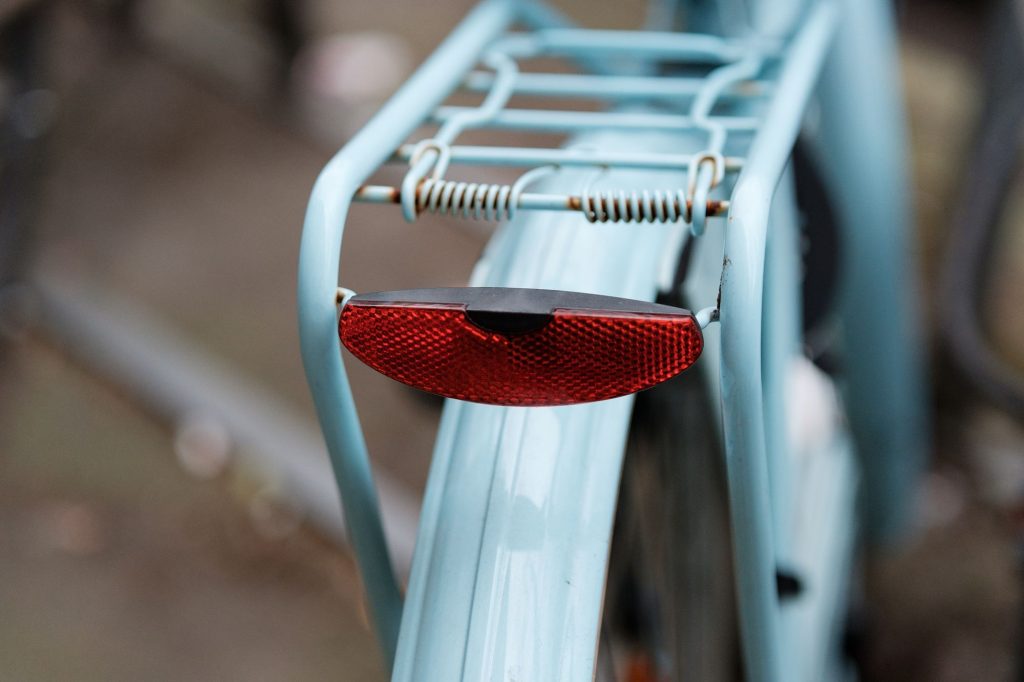
In the dark a bike must have a white light at the front and a red light at the rear. On top of that you need a red reflector at the rear and amber reflectors on the sides, and on the carriageway a hi-vis vest is compulsory. This is not a recommendation, it is what the Road Traffic Regulations require.
At the end of August the sun sets in Vilnius at about 20:30, by mid-September before 19:40, and once the clocks go back at the end of October it is dark before 18:00. The ride home from work or a club, which happened in daylight all summer, moves into dusk within a few weeks. This guide explains what the rules require, how many lumens you actually need, and how rechargeable, battery and dynamo lights differ.
The short answer: which lights do you need?
The choice depends on whether you need to be seen, ar to see the road. In town, where the streets are lit, the first is enough; out of town and on forest tracks you need the second.
| Where you ride | Front light | What else you need |
| Lit city streets | About 20–100 lm | Red rear light, reflectors |
| Suburbs, darker stretches | About 200–400 lm | Red rear light, hi-vis vest |
| Unlit road | About 400–800 lm | Backup power |
| Forest tracks at night | 800 lm and more | A second light on the helmet |
The figures are a rough guides, not a standard. Lumens measure only the total amount of light, not how it is spread: a well-shaped 300 lm light covers the road more evenly than a cheap 800 lm one that throws a bright blob and dazzles everyone else.
1. What the Road Traffic Regulations require
The requirements differ depending on where and when you ride. The general equipment rules cover a red reflector or a red light at the rear ir amber reflectors on the sides, fitted to the spokes.
Riding on the carriageway additionally requires either a hi-vis vest with reflective details, or lit lamps: white at the front and red at the rear.
In the dark, or when visibility is poor the requirement is strictest: the lights must be on and the vest must be worn. The rules change, and individual provisions are read differently, so before the season it is worth checking the current version of the Regulations.
In practice this means something simple: lights are needed in September, not in November when it is dark all the time.
2. How many lumens you actually need
The most common mistake is buying the brightest one going. In town an over-powerful light does not help, it gets in the way: it dazzles oncoming riders and pedestrians, and you yourself see poorly into the dark areas beside the beam.
- Up to 100 lm to be noticed on a lit street. That is what most rear lights;
- 200–400 lm to see potholes and kerbs on darker stretches;
- from 400 lm where there is no street lighting at all and you ride faster;
- 800 lm and more for forest tracks, where you need to pick out roots and rocks.
When choosing, more important than lumens is the shape of the beam: a good front light has a clear cut-off at the top, so the light falls on the road rather than into people’s eyes. It is also worth checking how many hours it runs on its brightest setting, because the quoted runtime is usually for the dimmest.
3. Rechargeable, battery or dynamo?
| Rechargeable (USB) | With batteries | From a dynamo | |
| Preparation | You have to remember to charge it | Replace the batteries | Nothing needed |
| Brightness | From modest to very high | Usually modest | Medium, steady |
| Cold | Capacity drops | Capacity drops | Does not depend on it |
| Who it suits | For everyday riding | For backup, occasional use | For town and touring |
Rechargeable lights are the usual choice today: no batteries to buy, and the brightness is adjustable. There is one drawback: you have to remember to charge them, and in the cold the battery runs down faster, so in winter it is worth carrying a spare battery-powered rear light.
Dynamo lights are unfairly written off as a thing of the past. A modern hub dynamo is barely noticeable when pedalling, and the light is always on with nothing to charge and nothing to think about. It is the most convenient option for anyone who rides every day, all year.
4. How to mount and aim them
- Angle the front light slightly down so the beam falls on the road about 5-10 m ahead, not into the eyes of oncoming riders;
- mount the rear light vertically, on the seatpost or the rack; tilted up it shines at the sky;
- check that the light is not hidden by a bag or a mudguard, which is the most common reason a rear light cannot be seen;
- in town choose a quick-release bracket, because when you leave the bike on the street it is worth taking the light with you.
Opinions differ on flashing modes. Flashing attracts attention better in town, but makes it harder to judge how far away you are, and on an unlit road it does not help you see. A practical compromise: flashing at the back, steady at the front.
5. Where lights do not help
Lights are visible from the front and the rear, but from the side you are all but invisible. That matters at junctions and when pulling out of courtyards, where a car approaches at right angles.
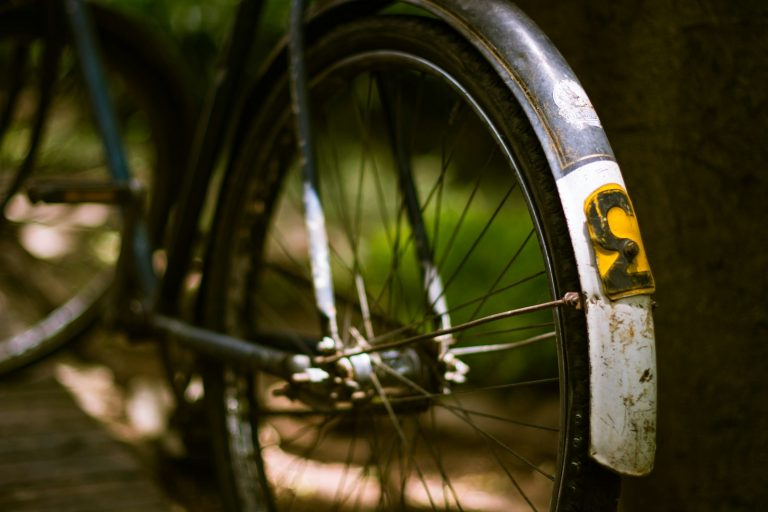
Side visibility is solved by amber reflectors on the spokes, reflective tape on the rims or tyre sidewalls, and reflective details on your clothing and backpack. In a car’s headlights they show up far sooner than a dark jacket.
Along with the lights it is worth checking the brakes: in autumn a wet road lengthens your stopping distance, and in the dark you spot an obstacle later. If the bike is going back into daily use after the summer, the seasonal servicing list will help too.
Frequently asked questions
Are lights compulsory on a bike?
Yes. In the dark, or in poor visibility, a bike must have a lit white light at the front and a red light at the rear. You also need a red reflector at the rear and amber reflectors on the sides, and on the carriageway a hi-vis vest is compulsory. Before the season it is worth checking the current version of the Road Traffic Regulations.
How many lumens should a bike light have?
For lit city streets up to 100 lumens is usually enough, because that is all it takes to be noticed. Darker stretches call for 200-400 lm, a completely unlit road from 400 lm, and forest tracks 800 lm and up. These are guides: what matters is not only the lumens but the shape of the beam, so that it falls on the road rather than into people’s eyes.
Flashing or constant: which is better?
In town flashing attracts attention better, but makes it harder to judge how far away a cyclist is. On an unlit road a flashing front light is no use, because you cannot see the road by it. A common compromise: flashing at the rear, constant at the front.
Rechargeable or battery lights?
Rechargeable lights suit everyday riding better: no batteries to buy, adjustable brightness, and prices from about €6. Battery lights work as a spare or for occasional use. In cold weather the capacity of both drops, so a spare rear light is useful in winter.
Are dynamo lights still relevant?
Yes, particularly for daily riders. A modern hub dynamo is barely noticeable when pedalling, the light is always on, there is nothing to charge or replace, and the cold does not affect it. The drawbacks are the higher initial cost and the fact that the dynamo has to be built into the wheel.
Are reflectors enough without lights?
No. A reflector only lights up when a car’s headlights fall on it, so it does not help where those headlights do not reach you, for example at a junction from the side or on a dark path. In the dark the rules require lit lamps, and reflectors are an addition, not a substitute.
In short: white at the front, red at the rear
The minimum is simple and cheap: a white light at the front ir red at the back. Rear lights start at about €3 and front lights at €3, while rechargeable models usually sit around €30.
In September the dark arrives gradually, and so it goes unnoticed: a week ago you got home in daylight, and now you ride the last kilometre at dusk. Fit the lights before that happens, not after.
If you are not sure what suits your bike, or you would like us to fit and aim the lights, drop into the Aštunkė workshop in Vilnius. A diagnosis costs €10.
📍 Daugėliškio g. 32A-133, Vilnius
🕙 I–V 10:00–19:00
Need help choosing?
Tell us your height, budget and where you ride, and we will pick a few models that genuinely suit you.