
Bike lock: how to choose one and how to lock your bike
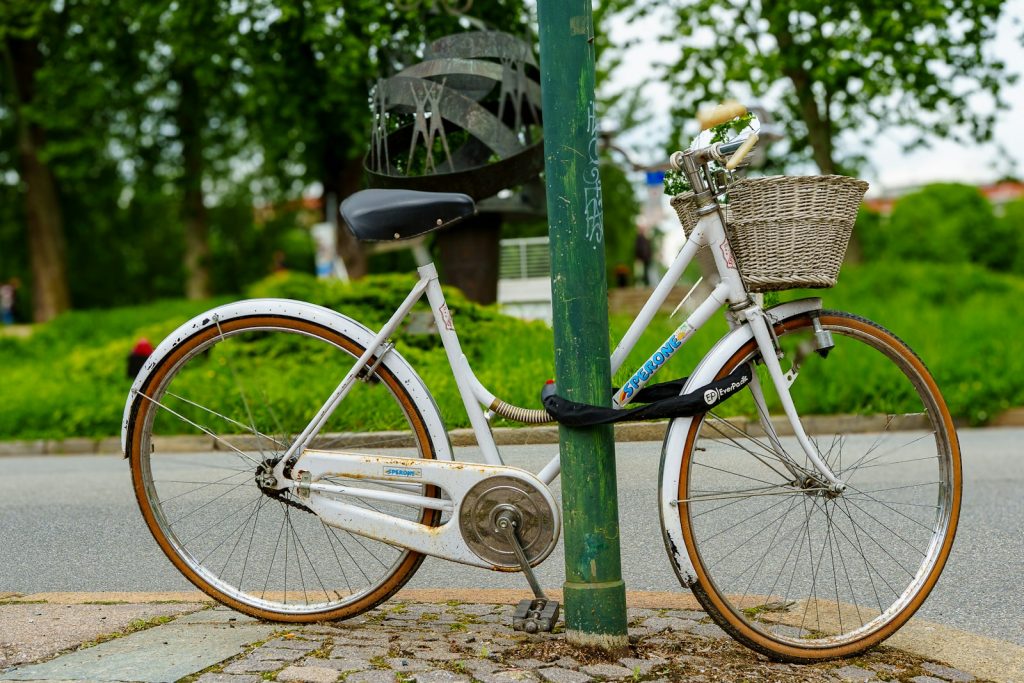
A bike lock does not protect you from a professional thief, it protects you from opportunity: a well-locked bike takes too much time and makes too much noise, so the thief picks another one. That is why what matters is not only the which lock, but also how you use it: the frame has to be secured to an immovable stand, not just the wheel to the frame.
In short: a thin cable is only good for a brief stop somewhere visible, while a bike left in the city every day deserves a folding or U-lock. This guide sets out how the lock types differ, how much is worth spending, what the markings on the packaging mean, and how to lock up the way the police recommend.
The short answer: which lock do you need?
| Where you leave it, and for how long | What is enough | Price in our shop |
|---|---|---|
| A few minutes outside a shop, somewhere visible | Cable lock | 3–47 € |
| Every day at work, school or the station | A folding or U-lock | 29–120 € |
| A courtyard, a stairwell, a shared bike store | A chain lock or a folding one | 40–120 € |
| An expensive bike left for a long time | Two locks of different types | from €60 for both |
We currently have in stock 34 locks from €3 to €120, with a median of about €24.
1. The types of bike lock
Locks differ less in the quality of the cylinder than in how hard the link itself is to cut. That is what decides how long a thief needs, and whether they try at all.
| Type | Advantages | Drawbacks | Price |
|---|---|---|---|
| Cable | Light, cheap and long, goes around the frame and the wheel | The weakest: a thin cable is cut with pliers in seconds | 3–47 € |
| Chain | Flexible, goes around thick stands; the fabric cover protects the paint | Heavy; the protection depends on the link thickness | 40–50 € |
| Folding | Hardened steel plates that fold into a compact package and fit on the frame | Dearer; shorter than a cable | 29–120 € |
| U-lock | A hard steel shackle, the hardest to cut; the best protection for the money | Rigid, and needs a stand of the right size | from €16 |
In practice this means: a cable lock is a deterrent, not protection. It is fine when the bike is left for five minutes on a busy street, but it is not enough for standing outside work every day. Folding locks and U-locks are the ones that genuinely buy you time.
2. How much to spend on a lock
A common rule of thumb among cyclists is about 10% of the value of the bike. It is not a rule, just a useful starting point: for a €300 city bike that means a lock of about €30, and for a €1,200 bike about €100.
The proportion matters more than the exact percentage. An €11 cable on an €800 bike is not thrift, it is pretence: it will stop a passer-by, but not someone with pliers in a backpack. Equally, a €120 lock on a €150 bike makes no sense. In that case two cheaper locks of different types are better, because the thief then needs two different tools.
3. What the markings on the packaging mean
The more serious manufacturers submit their locks for independent testing. The best known is the British Sold Secure system, where the lock is attacked with real tools and rated by how long it holds out:
| Level | What it means |
|---|---|
| Bronze | Holds for at least 1 minute against basic tools; protection against opportunist theft |
| Silver | Holds for at least 3 minutes against a wider range of tools |
| Gold | Holds out for at least 5 minutes of a determined attack |
| Diamond | Holds for at least 5 minutes, including 1.5 minutes against an angle grinder |
The numbers look small, but on the street five minutes of noise is a very long time. Look for the rating on the packaging or the manufacturer’s website. If there is none, that does not by itself mean the lock is bad, only that nobody has tested it independently.
4. How to lock a bike
A good lock used badly protects worse than an average lock used well. Vilnius County Police Headquarters publicly recommends the following:
- Lock the frame, not just the wheel. Secure only the front wheel and the bike rides away without it, since the quick release comes off without any tools.
- Lock it to something immovable. A bike stand, not a thin sapling, a railing or another bike.
- Use two locks of different types. One needs pliers, the other a saw or a grinder, and few thieves carry both.
- Leave it somewhere visible. On a busy street or in a courtyard with windows, not out of sight round the back of a building.
- Do not always leave the bike in the same place at the same time. A repeating routine is the most useful thing a thief can know.
- Lock it in the storage room too. A shared stairwell or cellar is not safe in itself. The door has to be solid, and the bike should be locked up inside as well.
A couple more practical points: keep the keyhole pointing down or sideways so water cannot get in and freeze in winter, and leave as little slack as possible between frame and stand, because the less room there is, the harder it is to get a lever in.
5. If the bike is stolen anyway
Your chances of getting the bike back depend heavily on what you prepared in advance. The most important thing is the frame number. This is a unique manufacturer’s code, usually stamped under the bottom bracket shell (where the pedal axle turns), and less often on a rear dropout or a frame tube.
- Photograph the frame number and the bike from the side while it is still in the garage.
- Keep the proof of purchase, it establishes ownership.
- If it is stolen, report it to the police and give the frame number, make, model and any distinctive features.
- Check the classified ad sites, because stolen bikes often turn up there within days.
Frequently asked questions
Is a cable lock enough?
For a brief stop somewhere visible, yes; for standing outside work or school every day, no. A thin cable is cut with hand pliers in seconds, so it works as a deterrent rather than as protection.
Which lock is best for a bike in the city?
A folding lock or a U-lock. Both have hardened steel parts that pliers cannot cut. A folding lock is easier to carry, because it folds up and mounts on the frame; a U-lock is usually cheaper for the same level of protection, but needs a stand of the right size.
How much should a bike lock cost?
The common rule of thumb is about 10% of the value of the bike. In our shop locks run from €3 to €120, and most people choose one around €24. For a city bike left outside every day, the realistic minimum is a folding or U-lock of about €30.
Lock the wheel or the frame?
The frame, always, secured to an immovable stand. If the lock is long enough, take in the frame and the rear wheel together. A front wheel with a quick release is best either secured with a second lock, or removed and locked together with the frame.
Is it worth using two locks?
Yes, and it is one of the most effective things you can do. What matters is that they are of different types, for example a folding lock and a cable lock. The thief then needs two different tools, and in most cases the theft stops being worth the effort.
Where do you find the bike’s frame number?
Usually it is stamped on the underside of the frame, below the bottom bracket shell where the pedal axle turns. You have to turn the bike over or lay it on its side. Less often it is on a rear dropout near the back wheel, or on the head tube. Photograph it in advance.
In short
A lock does not protect against everything, but it buys time and makes the theft not worth it. Keep the cable for short stops, and lock a bike that stands in the city every day with a folding lock or a U-lock, always through the frame and to a solid stand. Two locks of different types protect better than one expensive one.
If the bike stands outside all year round, a few other things are worth sorting out: lights for the dark months and seasonal servicing. And if a child cycles to school, it is worth going through locking habits together; we wrote about that in our article on cycling to school.
Not sure which lock suits your bike, or where to mount it on the frame? Drop into our workshop in Vilnius and we will show you and fit it on the spot.
Need help choosing?
Tell us your height, budget and where you ride, and we will pick a few models that genuinely suit you.